

Overview
A salwar kameez is two garments, so you need two groups of measurements. For the kameez or kurti: bust, waist, hips, shoulder, armhole, kameez length, sleeve length, sleeve round, front and back neck depth and slit. For the salwar, churidar or pant: bottom length, waist, hips, upper thigh, knee, calf and ankle or mohri. This guide explains each one, gives a standard size chart, and covers ease and common mistakes.
Before you start
Use a soft cloth tape in inches. Ask the client to wear a thin top and the bra she usually wears with suits. Have her stand straight with feet a little apart and arms relaxed. The tape should sit snug but not tight. For lower-body measurements, ask whether she wears the salwar at the natural waist or lower, because many women prefer lower.
Kameez and kurti measurements
Bust
Around the fullest part of the bust, tape level across the back.
Waist
Around the narrowest part of the torso, usually just above the navel. For a fitted kurti this shapes the side seams.
Hips
Around the fullest part of the hips, usually 7 to 9 inches below the waist. Ask the client to keep her feet together. This is the measurement most often skipped, and it causes kurtis that pull when sitting.
Shoulder
Across the back, from one shoulder bone edge to the other.
Armhole
A loop around the shoulder joint and under the arm, with one finger inside the tape.
Kameez length
From the highest point of the shoulder near the neck, straight down to where the kameez should end. Short kurtis, knee length and calf length styles are all common, so ask and show her in the mirror.
Sleeve length and sleeve round
Shoulder edge to the sleeve end, and the arm round at that point. For three-quarter sleeves, measure the round just below the elbow.
Neck depth (front and back)
From the shoulder near the neck down to the desired neckline, front and back.
Slit
From the waist (or from the hem upward) to where the side slit should start. Write down which way you measured.
Salwar, churidar and pant measurements
Bottom length
From the waist, where she wears the salwar, down to the ankle. For a churidar add the extra length for the gathers at the ankle. For a Patiala, the cut uses more cloth but the length is still taken from waist to ankle.
Waist (bottom)
Around the body where the drawstring or elastic will sit.
Hips
Same method as above. For pants and palazzos, this matters more than the waist.
Upper thigh and lower thigh
Around the fullest part of the thigh, and again just above the knee. Needed for churidars, leggings and fitted pants.
Knee and calf
Around the knee with the leg straight, and around the fullest part of the calf.
Ankle or mohri
Around the ankle bone for churidars. For salwars and pants, ask what bottom opening (mohri) she wants.
Standard salwar kameez size chart (inches)
This is a common starting chart similar to many Indian boutique and brand charts. These are body measurements. Sizes differ between shops, so use this as a guide, not a rule.
| Size | Bust | Waist | Hips | Shoulder | Armhole |
|---|---|---|---|---|---|
| XS | 32 | 26 | 35 | 13.5 | 15 |
| S | 34 | 28 | 37 | 14 | 16 |
| M | 36 | 30 | 39 | 14.5 | 17 |
| L | 38 | 32 | 41 | 15 | 18 |
| XL | 40 | 34 | 43 | 15.5 | 19 |
| XXL | 42 | 36 | 45 | 16 | 20 |
Kameez length and bottom length are not in the table because they depend on the client’s height and the style she wants. As a rough idea, a knee-length kurti for a woman of average height is often around 38 to 40 inches, and a salwar or churidar length is often around 38 to 41 inches. Always measure the real client.
Most women are not one size all over. A Medium bust with a Large hip is very common. That is why stitching to custom measurements is the main reason women go to a tailor instead of buying readymade.
Ease allowances
Common starting points for a regular fit:
- Bust: about 2 to 3 inches for a straight kameez, about 1 to 2 inches for a fitted one.
- Waist: about 2 inches.
- Hips: about 2 to 4 inches, so she can sit comfortably.
- Armhole: about 1 inch.
- Thigh and calf (churidar): about 1 to 2 inches, less for stretch fabric.
Anarkalis, A-lines and gowns get their flare from the pattern. Do not add extra to the body measurement for those. Cotton shrinks, so pre-wash or allow for it.
Common mistakes
- Skipping hips. A kurti can fit the bust and still pull at the hips.
- Measuring bottom length from the wrong waist. Ask where she ties her salwar.
- Forgetting the churidar extra. Without it, a churidar looks like a tight pant.
- Tight tape on the thighs. It gives a churidar she cannot sit in.
- Not writing the style. A number like “40” for length means nothing six months later unless you note whether it was a kurti, kameez or Anarkali.
Store the numbers once, use them every season
Regular suit clients come back again and again, for Diwali, for weddings, for office wear. Saving their measurements properly means you only need to check and update, not start over.
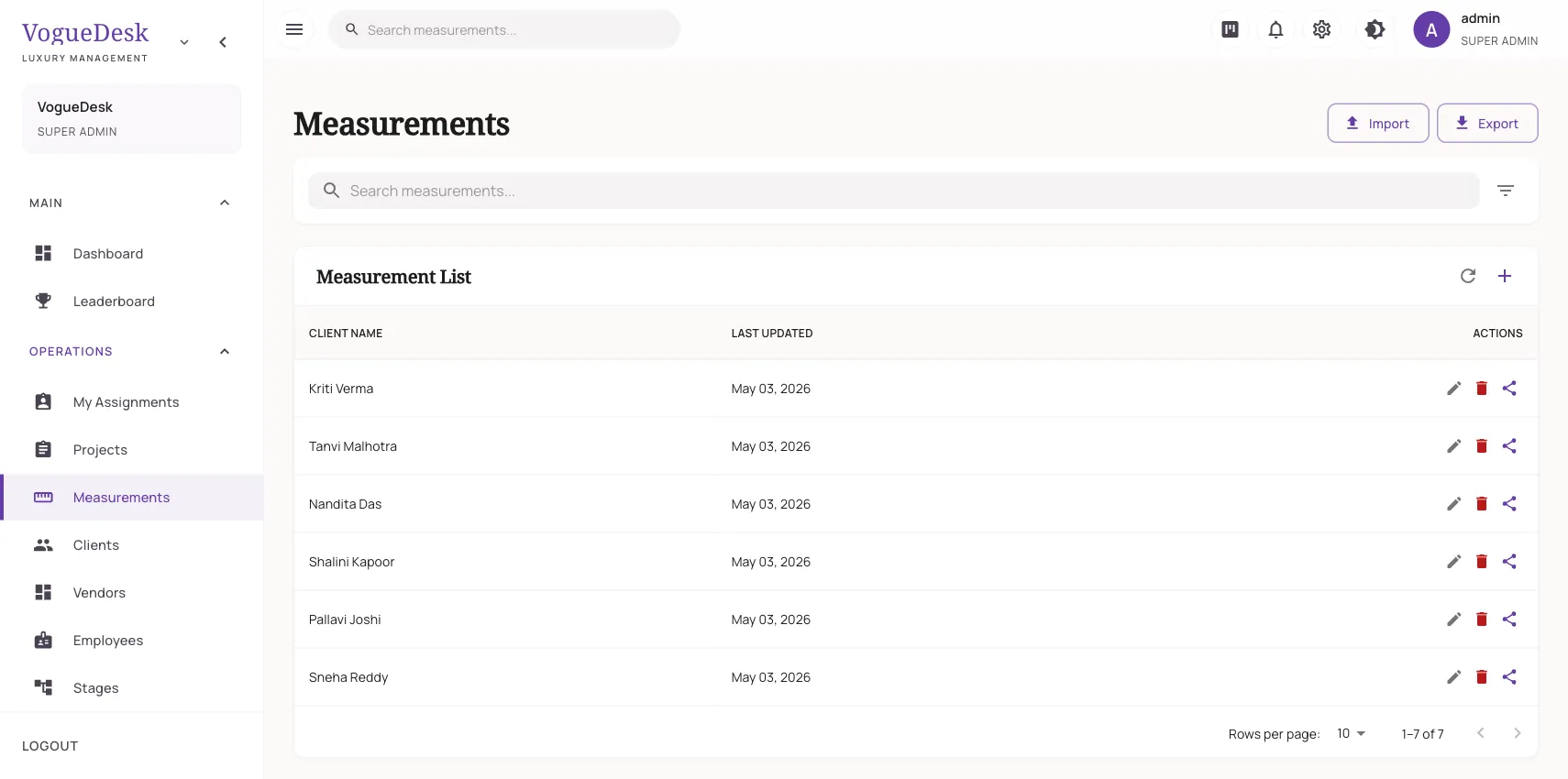
VogueDesk has fields for suit work including bust, waist, hips, shoulder, armhole, sleeve length, sleeve round, neck front and back, bottom length, waist-to-knee, upper thighs, lower thighs, knees, calf, ankle and slit, plus notes. You can keep several named and dated sets for each client, for example one for kurtis and one for fitted suits. If you already have measurements in Excel, save the sheet as CSV and import it. See the pricing page for plan limits.
Related guides: blouse measurement chart and lehenga measurement chart.
Frequently asked questions
What measurements are needed for a kurti?
For a kurti you need bust, waist, hips, shoulder, armhole, kurti length, sleeve length, sleeve round and front and back neck depth. Add the slit length if the client wants a specific side slit.
How do I measure for a churidar?
Take the waist, the full length from waist to ankle plus the extra length for gathers, and the rounds at the thigh, knee, calf and ankle. Churidars fit close, so the calf and ankle rounds matter more than for a salwar.
What is mohri in salwar measurement?
Mohri is the opening at the bottom of the salwar or pant leg. Clients often want a specific mohri, narrow for a cigarette pant style or wider for a Patiala look, so always ask and note it.
How much ease should I add for a kameez?
Many tailors add around 2 to 4 inches at the bust and hips for a straight kameez, and less for a fitted one. Anarkali and A-line styles get extra flare from the cut, not from the body measurement.
What size is a 36 bust in salwar kameez?
In most Indian charts a 36 inch bust is a Medium. But hips and waist often fall in a different size, so check all three before choosing a size, or better, stitch to custom measurements.