

Overview
Late deliveries are rarely about one lazy karigar. They happen because the boutique accepts more work than it can finish, garments wait for fabric or materials, trials are not planned, and nobody sees the problem until the delivery day. The fixes are simple: know your capacity, add buffer days, track every garment by stage, and update clients early. Here is how.
Why deliveries slip
1. Taking more orders than you can finish
In the wedding season and the Diwali rush, every client wants delivery before the same few dates. It is tempting to say yes to everyone. But if your karigars can finish 40 blouses a week and you accept 60, twenty clients will be disappointed, and you will not know which twenty until the last moment.
2. Karigar overload and absence
One master often handles all the cutting, or one karigar does all the handwork. If that person is overloaded, falls sick or goes home for a family wedding, everything behind them stops.
3. Waiting for fabric, lining or materials
The client brings the saree but not the blouse piece. The matching lining is out of stock. The latkans are coming next week. Work cannot start, but the delivery date was already promised.
4. Outside job work
Embroidery or dyeing sent to an outside worker comes back late, or comes back wrong.
5. Trials that are not planned
The client comes for a trial two days before the event, changes are needed, and there is no time left. Or she does not come at all, and the garment sits waiting.
6. No one can see the full picture
When orders are on slips, in a register and in WhatsApp chats, nobody knows how much work is due this week until it is too late.
Fix 1: Know your real capacity
Count roughly how many garments of each type your team finishes in a normal week. Do it per person, because a bridal blouse takes much longer than a simple one.
- Write it down: for example, “Ramesh: about 15 simple blouses or 4 designer blouses a week.”
- Add up the team’s total.
- Before giving a delivery date, look at what is already due that week.
When the week is full, offer the next free date. A clear “I can deliver on the 18th” is better than a promise you will break.
Fix 2: Add buffer days
Plan to finish each garment a few days before the promised date. Many boutiques keep a bigger buffer for bridal work and in peak season. The buffer absorbs surprises: a sick karigar, a late zip, an extra alteration after the trial.
If everything goes well, you deliver early and the client is delighted.
Fix 3: Do not start the clock until you have everything
Make it a rule: the delivery date is fixed once fabric, lining and design are confirmed. If the client still needs to bring something, write “date to be confirmed” or set the date from the day she brings it. Explain this politely at booking.
Fix 4: Track every garment by stage
Break each garment into stages, such as cutting, stitching, handwork, finishing and ready. Each stage has a person and a due date. Check the board every morning:
- Which garments are behind?
- Which karigar has too much?
- What is due in the next three days?
A wall board, a register with columns or software all work. The key is that everyone, including you, can see it in one minute.
Fix 5: Manage outside work tightly
Give every job worker a written slip with the return date. Follow up two days before. Keep a short list of reliable backups for the busy season, and book them early.
Fix 6: Plan trials at the time of order
Book the trial date when you take the order, with enough days after it for changes. Send a reminder the day before. For bridal orders, plan a trial a few weeks before the wedding and a final fitting closer to the date.
Fix 7: Prepare for the season before it starts
- Look at last year’s busiest weeks.
- Line up extra karigars or job workers in advance.
- Stock common linings, hooks, zips and threads.
- Decide a cut-off date for festive orders and announce it on WhatsApp and Instagram.
- Raise urgent charges for last-minute orders so they cover overtime.
Fix 8: Keep clients updated
Clients forgive delays they hear about early. They do not forgive surprises. Send short updates when the order is booked, when it is ready for trial, and when it is ready for pickup. If a date must move, tell the client as soon as you know, with a new date you are sure of. Our guide on WhatsApp order updates has ready templates.
A simple weekly routine
- Monday: list everything due this week and next. Move work between karigars if someone is overloaded.
- Daily: a five-minute check of the board. Chase late materials and outside work.
- Two days before each delivery: quality check, press and pack.
- Friday: call or message any client whose date is at risk.
How software helps
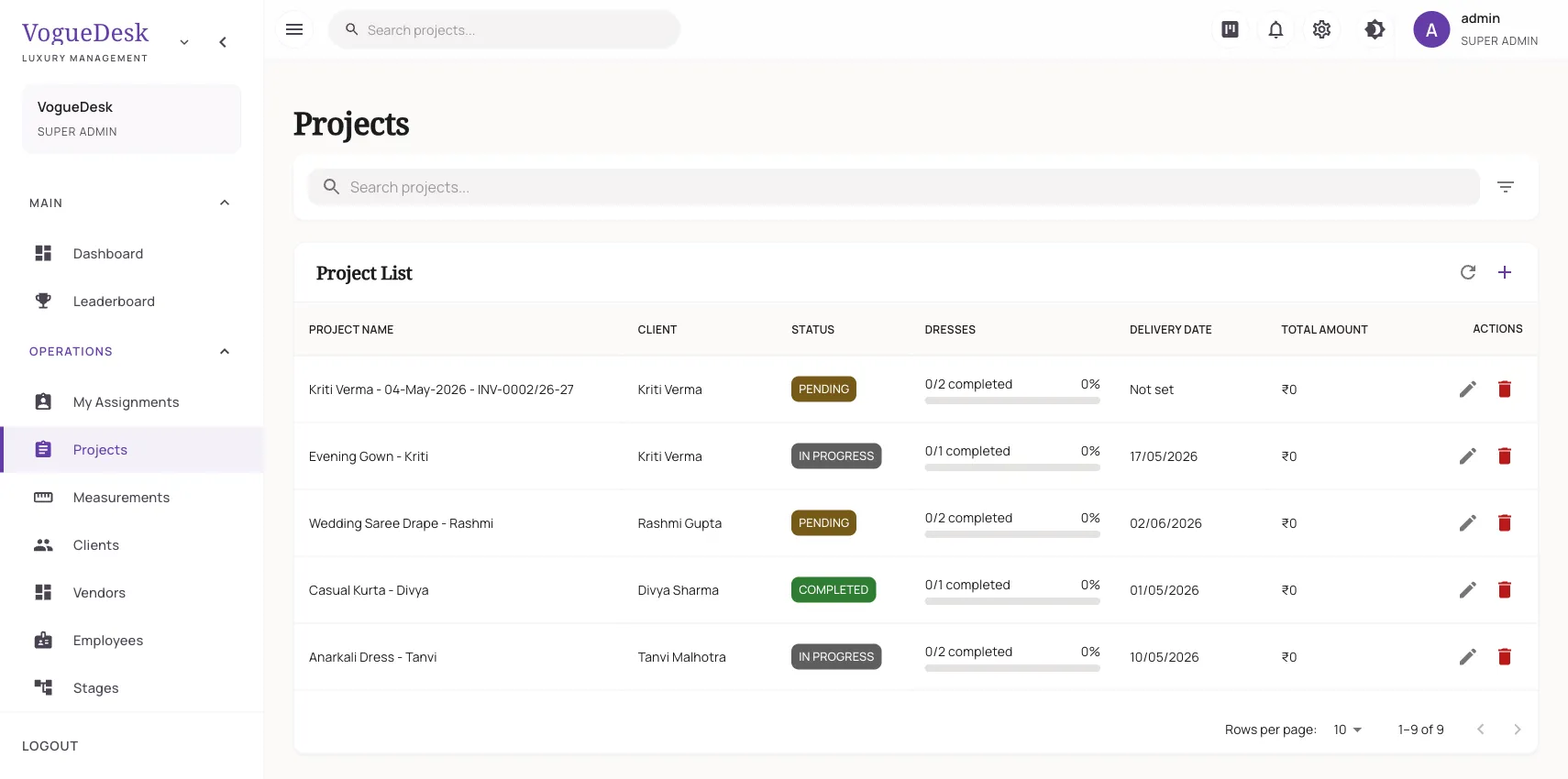
VogueDesk lets you set custom production stages, see work on a Gantt chart, and estimate delivery dates from the current workload. The capacity calendar and scheduler count both staff and contractors. Your dashboard shows deliveries due in the next 30 days, and each client can get an order tracking link to check status without calling. With a connected WhatsApp number, the boutique can send automatic messages when an order is created, ready and delivered. Plans are on the pricing page.
Overloaded karigars are the most common cause of delays. Read our guide on managing karigars.
Frequently asked questions
How many days should a boutique take to stitch a blouse?
It depends on your workload and the design. Simple blouses may take a few days in a normal week, while designer and bridal pieces take longer. Promise a date based on your current queue, not on how long the stitching alone takes.
How do I tell a client their order will be late?
Tell them as soon as you know, not on the delivery day. Apologise, give a new date you are sure of, and explain briefly why. If it is your mistake, offer something small, like free fall-pico.
Should I stop taking orders in wedding season?
When your capacity is full, yes, or offer a later date. Saying no or 'after the 20th' is better than taking an order you cannot finish and losing the client forever.
What are buffer days?
Buffer days are extra days between when you plan to finish a garment and when you promise it to the client. They absorb surprises like a sick karigar, late fabric or extra alterations.
How can I reduce trial-related delays?
Book the trial date at the time of order, keep enough days after it for changes, and remind the client a day before. For bridal orders, plan at least one trial a few weeks before the event.